

In the globally competitive business environment, enterprises must carefully choose their production strategies. OEM (Original Equipment Manufacturing) and ODM (Original Design Manufacturing) are two main outsourced production models. Each has its own characteristics and is suitable for different enterprise needs and market conditions.
This article will explain the differences between the two and analyze their advantages and disadvantages, so you can make more informed decisions for your enterprise after gaining a deeper understanding.
Definitions and Basic Concepts of OEM and ODM
OEM (Original Equipment Manufacturing) and ODM (Original Design Manufacturing) are two production models. OEM refers to a factory producing products according to the client's designs and specifications. ODM, on the other hand, is when the manufacturer independently designs and produces products, then sells them to brand companies.
Under the OEM model, the brand company is responsible for designing and promoting the product. The manufacturer is only responsible for production. This is suitable for enterprises that already have their own product designs.
The comparison table below helps you better understand the differences between the two:
| OEM | ODM | |
|---|---|---|
| Product Design | Brand company responsible | Manufacturer responsible |
| Production Manufacturing | Manufacturer responsible | Manufacturer responsible |
| Internal R&D Cost | Higher | Lower |
| Brand Control | Stronger | Weaker |
Key Advantages and Disadvantages of the OEM Model
The OEM model brings many benefits to enterprises. First, it allows companies to enter the market quickly. This way, brand owners can focus on sales and marketing. However, long-term reliance on OEM may lead to declining technological innovation capabilities. As a result, brand owners may lose their competitive advantage. Additionally, OEM manufacturers may become potential competitors, threatening the brand owner's market position.
| OEM Advantages | OEM Disadvantages |
|---|---|
| 1. Quick market entry | 1. Weaker product control |
| 2. Reduced production costs | 2. Innovation capability may decline |
| 3. Reduced R&D investment | 3. Manufacturer may become a competitor |
When choosing the OEM model, enterprises need to consider these advantages and disadvantages. Decisions should be made based on the company's own resources, capabilities, and long-term development strategy. Sometimes, combining OEM with independent R&D may be a better choice. This way, you can enjoy the benefits of OEM while maintaining core competitiveness.
Key Advantages and Disadvantages of the ODM Model
However, the ODM model also has some disadvantages. Brand owners may lose control over product design. This could reduce product differentiation. At the same time, excessive dependence on ODM manufacturers may affect the brand's long-term competitiveness.
| ODM Advantages | ODM Disadvantages |
|---|---|
| 1. Lower R&D and production costs | 1. Lower degree of product differentiation |
| 2. Shorter product development and time-to-market | 2. Higher dependency on ODM manufacturers |
| 3. Focus on brand marketing and sales | 3. Lower mastery of core technology |
When choosing the ODM model, enterprises need to evaluate their own needs and long-term development. Properly utilizing the ODM model can help enterprises rapidly expand their market. But at the same time, they should also be mindful of maintaining innovation capability and brand distinctiveness.
Differences Between OEM and ODM in Product Development Processes
OEM and ODM are two different cooperation models. Under the OEM model, the client company is responsible for product design and development, while the manufacturer handles production. Under the ODM model, the manufacturer is responsible for everything from concept to finished product.
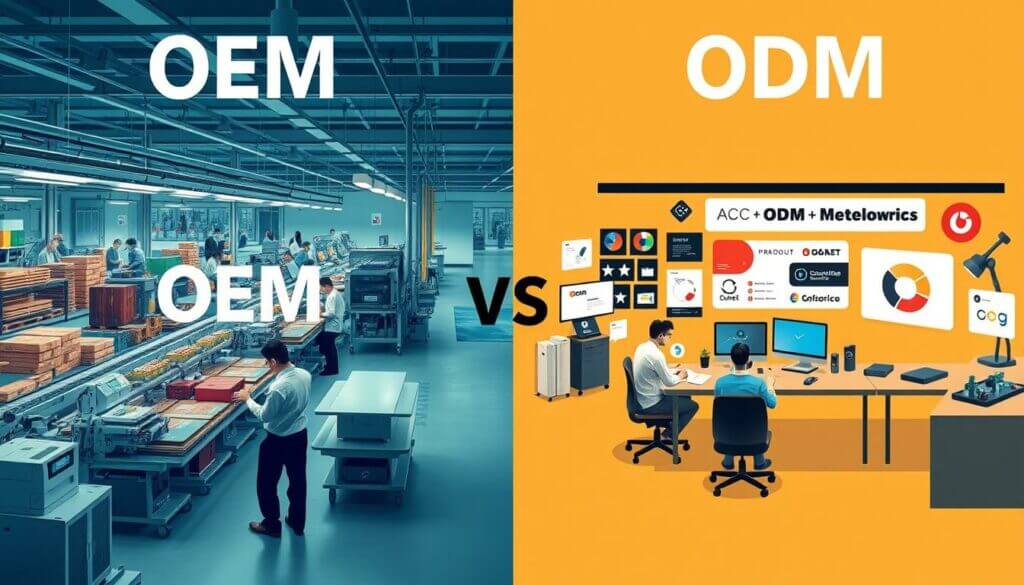
In contrast, the ODM model puts the manufacturer in charge of product development. Leveraging their extensive experience and technology, they can quickly propose innovative designs. The client company can choose from the designs offered by the manufacturer or request modifications.
| Development Stage | OEM Model | ODM Model |
|---|---|---|
| Concept Design | Client company | Manufacturer |
| Product Specifications | Client company defines | Manufacturer suggests, client selects |
| R&D Process | Client-led | Manufacturer-led |
| Production Manufacturing | Manufacturer executes | Manufacturer executes |
When choosing which model to adopt, enterprises need to consider their own R&D capabilities, funding, and market strategies. Understanding the differences between these two models helps enterprises make better decisions.
Key Factors to Consider When Choosing OEM or ODM
When choosing between OEM and ODM, enterprises should consider several important factors. First, the company's core competitiveness and long-term development strategy are crucial. If the company excels in design and R&D, ODM may be more suitable.
Second, funding and resources are also important. The ODM model requires more upfront investment to develop products, while OEM requires less capital. Enterprises should also assess their own production capabilities and technical levels to ensure they can meet their partners' requirements.
Market demand and the competitive landscape should not be overlooked either. If the market has high demand for customized products, ODM may have an advantage. Facing intense market competition, OEM can help enterprises quickly launch products and capture market share.
- Core competitiveness and development strategy
- Funding and resource situation
- Production capability and technical level
- Market demand and competitive landscape
- Product lifecycle and innovation needs
Finally, considering the product lifecycle and innovation needs is also important. For products that require frequent updates and innovation, the ODM model offers greater flexibility. By comprehensively weighing these factors, enterprises can make the choice that best suits their own development.
The Impact of OEM and ODM on Brand Development
Brand building is very important for enterprises. Both OEM and ODM models have profound impacts on the brand. The OEM model allows enterprises to focus on production, but brand awareness may not be high.
| Impact Dimension | OEM | ODM |
|---|---|---|
| Brand Awareness | Lower | Higher |
| Technical Strength | Average | Stronger |
| Innovation Capability | Limited | Higher |
| Market Response Speed | Fast | Slower |
| Brand Value | Lower | Higher |
Enterprises need to choose the appropriate model based on their own circumstances. The OEM model is suitable for short-term profits, while the ODM model is more suited for long-term development.
Regardless of which model is chosen, improving product quality and service levels is key. This is an essential factor for sustained brand development.
The Role of OEM and ODM in Global Supply Chains
OEM and ODM play very important roles in global supply chains. They allow enterprises to focus on their core competitiveness. Under the OEM model, brand owners are responsible for design while manufacturers handle production.
Brand owners typically retain design control.
As globalization accelerates, the importance of OEM and ODM continues to grow. They help enterprises reduce costs and promote the flow of technology and knowledge. However, this also brings challenges, such as intellectual property protection and quality control.
| Model | Advantage | Challenge |
|---|---|---|
| OEM | Strong brand control | Higher production costs |
| ODM | High cost-effectiveness | Difficulty in brand differentiation |
Overall, OEM and ODM play important roles in global supply chains. They provide enterprises with diversified production strategy options. With technological progress and changing market demands, these two models may further converge and evolve.
Future Trends: The Evolution of OEM and ODM Models
The concepts of smart manufacturing and Industry 4.0 are changing how OEM and ODM operate. These technologies make production processes more efficient while improving product quality and customization. Many OEM and ODM suppliers are investing in automation and data analytics technologies to enhance competitiveness.
Sustainable development has also become an important driving force in the evolution of OEM and ODM models. Consumers are increasingly concerned about environmental issues, prompting manufacturers to adopt more eco-friendly production methods and materials. Some ODM companies have even begun focusing on developing recyclable and biodegradable products.
Additionally, the boundaries between OEM and ODM are becoming blurred. Some ODM suppliers have begun offering more comprehensive services, including design, production, and after-sales support, forming the so-called ODM+ model. This trend enables ODM suppliers to provide greater value to clients while also improving their own profit margins.
In the future, we may see more OEM and ODM companies shifting toward providing comprehensive solutions rather than merely manufacturing products. This transformation will make them strategic partners for their clients, not just suppliers.
Case Analysis: Success Stories of Enterprises Using OEM and ODM
The collaboration between Apple and Foxconn is a classic OEM model case. Foxconn produces the iPhone, iPad, and other products for Apple. This allows Apple to focus on design and brand marketing.
This cooperation model helps Apple maintain its innovation advantage while also ensuring high product quality and large-scale production.
ASUS Computer is a representative of successful ODM model utilization. ASUS not only produces computers for its own brand but also provides ODM services for other well-known brands such as Dell and HP.
These two cases demonstrate how OEM and ODM models create value for different types of enterprises. Choosing the right model is crucial for a company's long-term development.
Conclusion
OEM and ODM are important forms of enterprise cooperation. OEM allows brands to focus on design and marketing. ODM provides comprehensive product development services.
The choice of which model depends on the enterprise's resources, capabilities, and market strategies. Both models are very important in global supply chains.
They promote industrial division of labor and improve production efficiency. With technological progress and market changes, the boundaries between OEM and ODM are becoming blurred.
In the future, enterprises need to flexibly utilize OEM and ODM models based on their own strengths and market demands. Success stories show that properly selecting and utilizing these models can bring competitive advantages.
Regardless of which model is chosen, maintaining innovation, quality control, and brand building are key. These are essential factors for long-term enterprise success.